søndag 13. mars 2016

Technology promoting health in Balaka

NCA is partnering with DREAM project in Balaka, which is in the south-eastern part of Malawi.  This week we had our friends Toril and Helge visiting us, and this gave a good opportunity to pay the DREAM project a visit.  DREAM ( Disease Relief through Excellent and Advanced Means)
is a project of Sant Egidio Community, a lay Catholic community well established in Malawi.

The DREAM project is promoting technology to improve quality of health services.  Data management is extremely important in order to effectively register clients and follow them up systematically.  The photo below shows how DREAM in Balaka keeps record of around 20,000 clients in the district, of which around 5,000 are HIV/AIDS positive.


All pregnant women in the districts are supposed to be registered and follow a regular schedule of check-up.  If they do not turn up, field assistants will reach out to them and encourage them to come for check-up.  We were told that during the last month, only one pregnant woman had failed to follow the regime. The woman in the photo below was one of the many who had followed the regime both before and after giving birth.


HIV testing is a key component of the work, and a well functional laboratory is part of the Balaka health centre.  A number of different tests could be carried out through the skilled work of professional technicians.  Their capacity for testing for HIV is around 200 per day, while lack of additional technical staff prevents the laboratory from carrying out another 100 tests.  We were quite impressed by the physical environment, the instruments and the professional regime that obviously kept a very high quality.  It was humbling and gratifying to know that NCA is able to support this quality service in an otherwise poor country context.


One of the components of DREAM's work in Balaka district, which include far distance places, is the satellite field clinics in which mobile health teams visit weekly.  Through installation of solar power, the basic technology needed for the operations can be carried out also in these clinics.  We visited one of these clinics and heard the witness of its importance for the local community.


Clean water is fundamental to health, and the hand-pump at the health centre was serving the centre and the surrounding community.


Having experienced this important work on the ground, it is painful to admit that we in NCA may perhaps have to end the support for this work at the end of this month.  We have been informed that financial support for our health programme through the Norwegian Embassy has been stopped as of 2016.  Increased allocations to respond to the Syrian humanitarian disaster and the refugee crisis in Europe have led to reduced budget for Malawi development assistance. This, combined with political decisions to change thematic priorities for official Norwegian assistance to Malawi have been given as the main reasons. Our Embassy supported health programme has been on-going since we entered Malawi in 2002, and has had multi-million budgets in Norwegian kroner.  While we are exploring to fill part of the gap from alternative sources, we have to go through painful cuts to our partner projects.

No decision has been made about the support to DREAM, but the future is uncertain.  This is a great pity since DREAM very much relies on NCA support for this work.  Quality service is crucial to keep the level of HIV infected people down.  The systematic DREAM efforts have contributed to a stabilization, and even a decrease in HIV infected persons in Balaka district.  What will happen if this activity has to be scaled down!?  Challenges are certainly ahead!


søndag 6. mars 2016

Stimulating children, - keeping them off the streets

You who have followed my blog, ... regularly or once off ... you have noticed my silence for a lo-o-o-ong time.  I am back on air, and intend of keep it up with a certain regularity.

Now I am fortunate to have been joined by Birgit, my wife.  Being a fresh retiree she is trying to adjust to a new situation.  She enjoys to join me on field trips, and some days ago we jointly went to the inauguration of Chitawawa community based children's centre.  Chitawawa is some distance outside Lilongwe, but not further away than Lilongwe attracts a number of children from this community.  They end up on the streets, begging for a living, or committing petty-crime to survive.  Chisomo Children's Club is an organization that is committed to work with street children, including efforts to prevent children to end up in the streets.  One of the measures is to work through community based children's centres.  The centres are multi-purpose buildings that can be used for kindergarten, pre-school, awareness building for parents, and some times mother - child health checks.

NCA is supporting Chisomo Children's Club, and I was invited to participate in the inauguration of  the Chitawawa centre.  As you will see, the building is decorated with lively and educational illustrations.


Playground toys are part of the centre,


and Lego toys and other toys are available.


More importantly, about 15 caretakers have been trained to activate and support the children who attend the centre.  More than 300 children are regular visitors, and therefore the centre is more than an empty building.  It is a busy place for constructive caring and teaching of children.


The official inauguration was made by the Minister of Children, Disability and Gender, and she cut the ribbon.  As you will see, I was asked to assist the Minister.


As is the tradition, such event included speeches, including speeches by the Minister and myself, cultural show, singing and dancing.


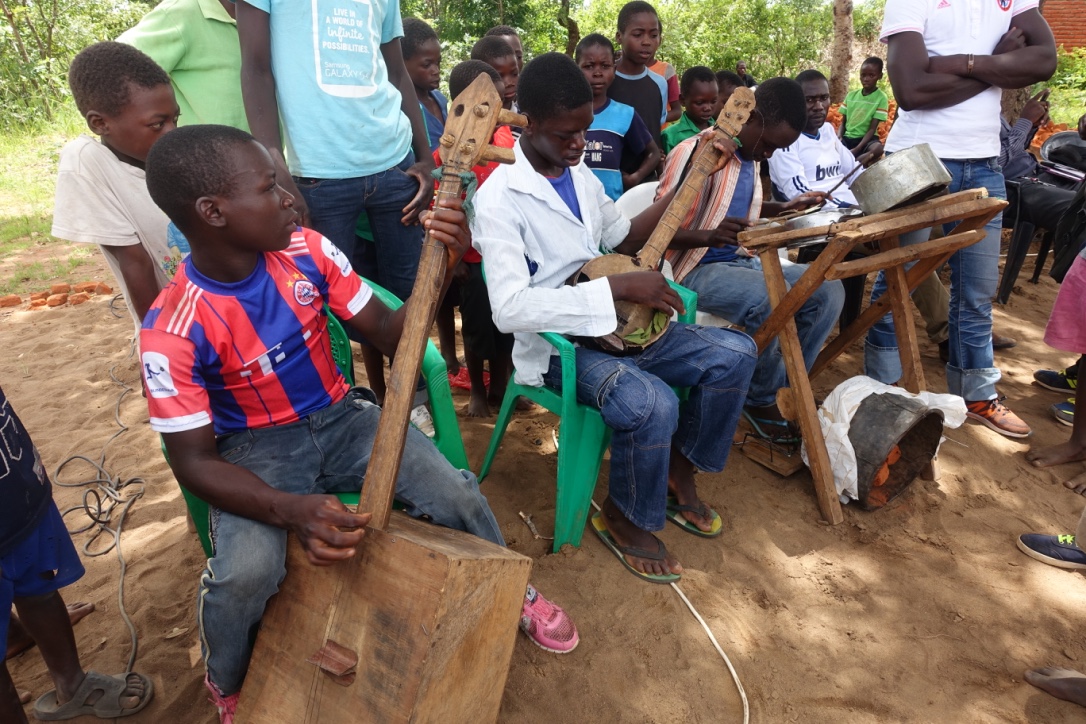
An interesting contribution was the band you see below.  The instruments were entirely home-made, but I can tell you that there was no problem with the sound and rhythms coming out of their band!


The community elders praised the new facility, and claimed that this could be a defining event for the children of this area.  Let us hope they are right!


lørdag 10. oktober 2015

"We Have Faith", climate campaign Maputo - Nairobi

COP 21 - the climate summit in Paris in December will be crucial in the global efforts to deal with climate change.  Faith communities in Southern Africa have seen this summit as worth campaigning for.  "We Have Faith" was therefore coined as the slogan for the campaign, and a long bicycle relay is currently on its way from Maputo through nine countries with the aim of reaching Nairobi mid-November.  This week the relay crossed the border from Zambia to Malawi.  The route so far took the bicycle caravan through Mozambique, South Africa, Zimbabwe, Botswana and Zambia before entering Malawi.  15 competitive cyclists received the baton at Mchinji border, and was joined by a number of bicycle taxi drivers... and Stein.


The caravan will continue through the country to its northern border with Tanzania, and continue through Tanzania to Kenya. A group from Uganda will also join the relay before ending up in Nairobi.

The Zambia and Malawi teams were met in Mchinji town after the "prologue" from the border by religious leaders, including the Catholic Archbishop of Lilongwe and government representatives.  At the sports ground the formal handing over was taking place, and appeals were made.  National television was present, and the event was covered as one of the top stories during evening news.


While the bicycle caravan is making the campaign visible in town, the aim is to have a petition for Paris signed by one million people during the relay.


Today there was a big event at one of the stadiums in Lilongwe with speeches, poetry, traditional dances and display of the bicycle caravan.  Majority of patrons were secondary school youths who kept the spirit high through their enthusiastic cheering and clapping.

Mosques, temples and churches have been given "teasers" for the respective sermons Friday, Saturday and Sunday.  The climate message will hopefully be heard throughout the faith community this weekend.

Climate change is a burning issue in Malawi.  Devastating floods hit in January/February, followed by drought and food crisis.  Forest has been cut without proper replanting, and run-off is causing major damage every rainy season, and seasons are more unpredictable than they used to be.  Malawi, being one of the poorest countries in the world is struggling with the economic consequences of climate change.  One of the "We Have Faith" demands is climate justice:  those who cause the major climate changes should pay up!  A youth made the following statement in today's event: "Climate change is different from HIV and AIDS,... it hits us ALL".  Very true, my young friend!

søndag 4. oktober 2015

Politics, economic challenges... and stewardship

Radio and television stations have limited hours of English service in this country.  I therefore rely on newspapers to keep somehow updated on goings-on in the Malawian society.  Fortunately the press is rather outspoken, and deals blows both left and right.  It is hard to know how reliable they are on facts, but issues are brought out in ways that keep power-brokers on their toes.

During the last weeks a number of issues have coalesced into a serious question to the government's stewardship of Malawi's resources.  Earlier this year the Parliament adopted a national budget without external budget support, due to the so-called Cash-gate corruption scandal that rocked the nation in 2013-2014. "Austerity budget" was the term used about the budget.  This budget came on the tail of the devastating flood emergency that displaced hundreds of thousands of people and destroyed major crops in January and February.  Soon reports started to emerge on shortfalls in health sector.  Drugs were not available, ambulances were grounded due to lack of money for fuel and repair, newly graduated nurses were not hired in the allocated jobs...


Ambulances grounded due to lack of money to buy fuel!

Two weeks ago the President declared a food-emergency, announcing that 2.8 million people would be in need of food aid during the next few months due to the failed crop season.  This week the Vice President used the figure 3.3 million people.


At the time of these announcements, an International Monetary Fund delegation visited the country and declared that the government was off track with their economic performance.  The spending has been too high, and a revision of the budget in order for the country to get on track is necessary.  Further tightening of the belt even more is necessary.  


The newspapers obviously follow these developments with critical eyes, and the government is constantly under fire for lack of action, for condoning corruption, and spending money wrongfully.

This last week media found a new issue to pursue.  When the President left for the opening session of UN General Assembly in New York, media claimed that he brought with him a delegation of more than 120 people.  This brought about a big uproar, since millions of US dollars were spent of taxpayers' money.  One of the very poorest countries of the world was sending an extremely bloated delegation "on shopping spree in New York" was the take in media.  While the President's spokesperson claimed that less than 20 people were in the President's delegation, sources within the US embassy informed that number of visas issued tells another story.


What type of stewardship are we witnessing?  Media ask:  "why is Malawi still extremely poor"?  There are obviously a complicated cocktail of answers that need to be explored. Political, economic and developmental analysts are offering their viewpoints in the newspaper pages.  No single solution is prescribed, but the fourth state power is attempting to do its job:  put important issues up for scrutiny and debate.  People in power are challenged.  How are they responding?  The jury is still out!


søndag 20. september 2015

The gated community

I have been silent for a couple of weeks, and it is time to reconnect.  A visit to Harare upset my writing schedule.  Besides attending a regional meeting of ACT Alliance, I had the chance to meet up with my old colleague from DanChurch Aid, Christian Baleslev Olesen, who is now representing the organisation in Zimbabwe.  While waiting for our flight back to Lilongwe, he invited us for a walk in a wildlife park.  While the path was taking a sharp turn to the left, we suddenly realised that the path was already occupied by another living creature:

A python of 2 1/2 - 3 meters blocked the path.  It did no harm to anybody, and after having secured the documentation above we continued our pleasant walk,... although with a slightly heightened alert.


In my previous blog I visited the entrepreneurs behind the wall of my residence.  This time I will take you even closer.  Now is the time for the Jacaranda trees to bloom on bare branches.  As I walk outside my gate I get the full view of a flower-covered tree.  This is perhaps what catches your eyes when you look at the photo below?


Look a bit lower in the picture and you see the view of "my street", a street with plenty of potholes... and walls and gates.

Lilongwe is a relatively safe city compared to other African capitals.  Walls and gates are nevertheless a conspicuous feature in residential areas.  Why would we wall ourselves in, if the environment is rather safe?  Perhaps the city is not viewed as totally safe after all?


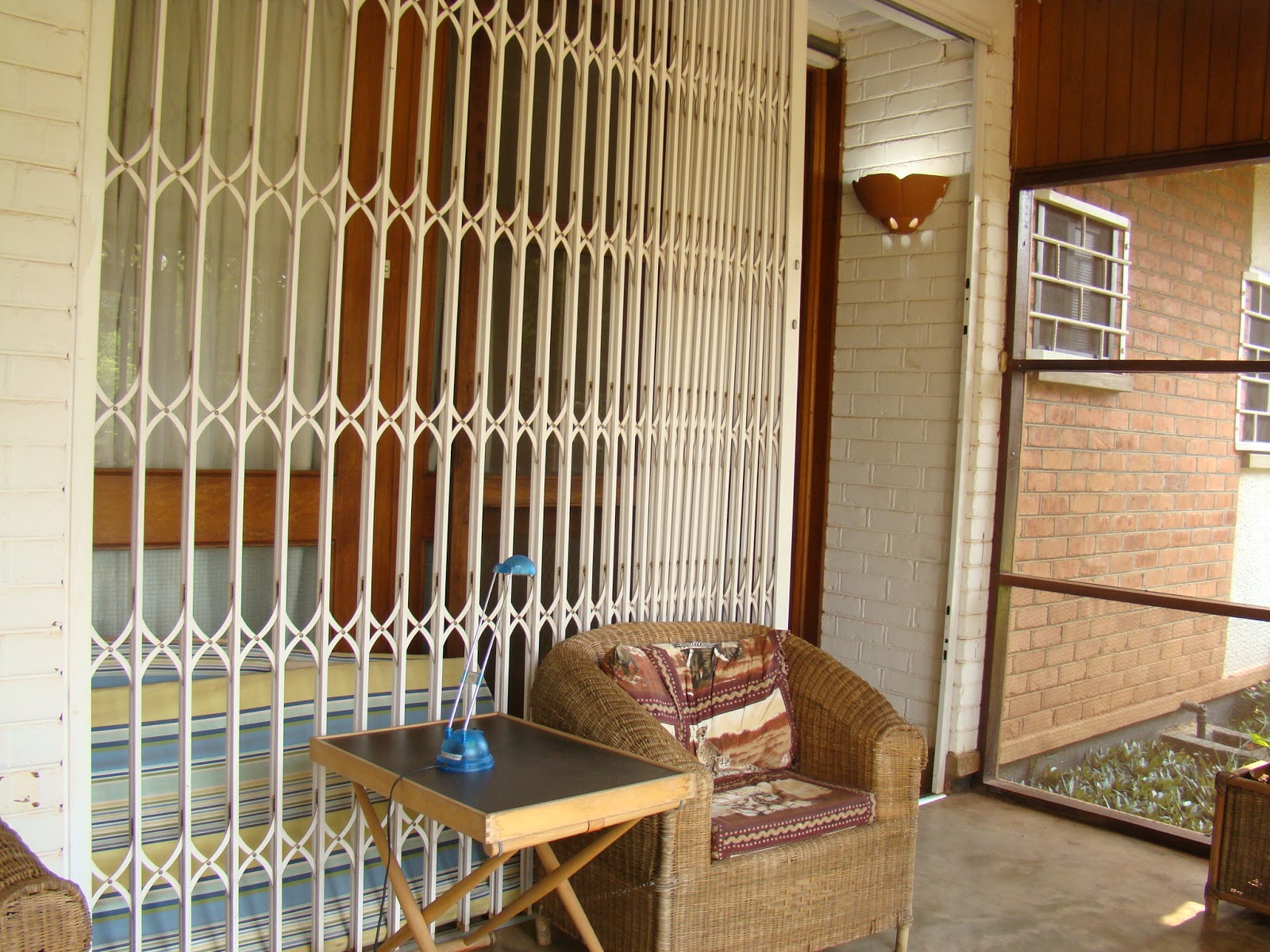
My watchman and his colleagues are on duty 24/7,...and the wall is topped with electric wires!  This is not enough.  Behind the walls the house is also fortified with steel-meshes that are being locked at night.


Are we completely paranoid, or are there good reasons for all these security measures?  I honestly believe the level of precautionary measures reflects a slight paranoia.  At the same time I recall my visit behind the wall where I encountered makeshift workshops and shops, and dusty roads leading into more or less shacks serving as homes.  Malawi's poverty is right on my doorstep, and my luxury life inside the wall (although fairly moderate according to Norwegian standards) is obviously a huge contrast to the struggle for life that is the reality behind my wall. Desperation may lead to actions of crime that could descend on us behind the walls. As individuals we cannot change the social injustice, and therefore physical measures are put in place to protect against repercussions of the injustice.

The contrast between the have's and the have not's is enormous in Malawi, as in many African countries.  My money can protect me from poverty, by closing it out behind my wall, and my money can provide almost anything in the shops.  Commodities are available... if you have enough money to spend.  I can therefore live a comfortable life in my gated community!


lørdag 5. september 2015

My entrepreneurial neighbours

While sitting outside reading today's Saturday paper I kept noticing a sound from behind the wall that caught my attention.  Was it a cutting torch that was at work?  It struck me that I had not really explored life behind our wall, and decided to go for an exploratory walk.

As I reached around the block and recognized our water tank... this time behind the wall... the origin of the sound appeared.  It was indeed a cutting torch at work, and the man who handled the tool was apparently an artist working in steel.  Kondwani, as I learnt to be his name, was surrounded by a welding machine, hammers and cutting machines.  Two steel birds were emerging from the iron sheets and pipes that artistically were formed into tails, wings, legs and bodies.  On one side some finished birds and a cheetah were on display.


In my curiosity I asked him where he had learned his trade.  He narrated that his basic skills had been obtained at a technical school in Blantyre.  Welding, cutting and body work formed the starting point. While he tried his luck as a car mechanics for a while, his dream was to utilize his creative abilities.  He was digging deep into his pockets and went to Zimbabwe to learn sculpturing.  Jobs were not to be found in which he could use his new-won skills, and he had to start his own business.  Together with his brother he bought basic tools and started producing sculptures and receiving cars for repair along the roadside. Gradually business picked up, and now they form a group of four who work together.  They built a shed as a basic workshop, and bought a container as a store.


"So, who buy your birds and animals?" I asked.  "People like you!" he replied with a hopeful smile. Perhaps another day...?

Not far from the makeshift workshop I stumbled upon a man who apparently was making shoes under a iron sheet covered structure, also along the dusty roadside.  Right behind him three-four men were busy repairing bicycles.


In my afternoon walk just behind the wall of our house I had obviously encountered entrepreneurs who made a living based on their acquired skills,  but under extremely basic conditions.  Steven, as my shoemaker called himself, had no formal training.  He was raised as a neighbour to a shoe factory, and used his eyes and hands wisely as he tried in his own ways to copy what otherwise machines were shaping out of the hide.  With leftover hide from the factory he developed his craft and started his business.


The shoe on display was my size.  It lacked soles, but I could easily envisage the pair as slippers, ... and they are on my feet as I write this small piece.

tirsdag 25. august 2015

"Culture" and culture...

This weekend I was as usual buying and reading two newspapers on Saturday and two on Sunday.  Weekend papers are a mix of local news, opinions, promotional pull-outs, feature stories and cuts and pastes from international media. During the week I try to understand the politics of this country, societal challenges and developmental efforts.  Weekends give me more of the "soul" of the country.


One article caught my eyes in the Sunday paper.  A chief was decrying "Western culture", describing it as a threat to Malawian culture.  What was this "Western culture" that caused his constipation?  With interest did I realise that he was referring to proposals for production of marijuana to replace tobacco, and legalization of commercial sex.  He was then listing other "ills" coming from outside, and ending with ..."...the coming in of democracy has eroded everything".

These lamentations come in the midst of a national struggle to rid the country of child marriages, trafficking of persons for child labour, and attacks on albinos for the magical power of their body parts... These traditions are said to be inherited from Malawian history. What is it about this culture that is drastically better than "Western culture"?

It struck me how we very often reflect on "us" and "them.  We contrast the worst in "their culture" and romanticize about "our culture", and do not relate the best or worst in the respective cultures with each other.  We make connections that probably are not relevant.  In this case the blame was on introduction of democracy... How often did we not hear the reverse story about the "savage natives" of Africa that needed to be saved from themselves?

Living in Malawi gives me a golden opportunity to confront my own stereotypes when encountering stereotypes presented by others.  So far during my stay in Malawi I have experienced a rich culture which has been influenced by local and regional history... and greatly flavoured by other cultures, including "Western culture".  Nuances are found between rural and urban areas, between age groups and men and women.  The Malawian culture is not what it was yesterday, and will be different tomorrow compared to today.  I am fascinated by the different flavours of culture that surround me!

Talking about flavour of culture... and nature.  My newspaper reading was enjoyed amidst colourful vegetation in a beautifully trimmed garden, credit our gardener Gani.  Just see for yourself!