søndag 16. august 2015

Christianity encounters local culture


This small piece will take us back to Mua Mission.  Yesterday there was a major cultural festival with dances, plays and poems from the local communities.  Hundreds of local people and a few number of visitors from afar were crammed into the outdoor auditorium/theatre.


The day started with a Catholic Mass led by the founder and leader of the Kungoni Centre of Culture and Art, Fr. Claude Bouchet.


A significant part of the mass was the participation of a large group of traditional Ngoni dancers and singers.  Their traditional rhythms and songs were given texts that flowed with the progress of the mass.

The theme of the mass was “Nature and Culture”, inspired by the recently published encyclical by Pope Francis on Environment and Climate.  We heard the recital of the lamentation of the tree, and we witnessed the planting of a tree. 


All this in full harmony between the Christian mass and the traditional culture. The African philosopher John S Mbiti is describing in his book “African religions and philosophy” how African rites and traditions penetrate African individuals and communities in existential situations, involving life and death, and overrule Christian rituals.  His claim is that the missionaries left African Christianity too shallow because they were not willing to de-socialize their outlook from the European heritage and re-socialize Christianity to the local history and traditions.  Local traditions were dismissed and discarded outright, and were not explored in order to find confluent values and perspectives from where Christianity could bridge with local history and tradition. 
What we experienced yesterday was a result of Kungoni’s many years of promoting enculturation, an important attempt to blend global faith tradition with local culture.
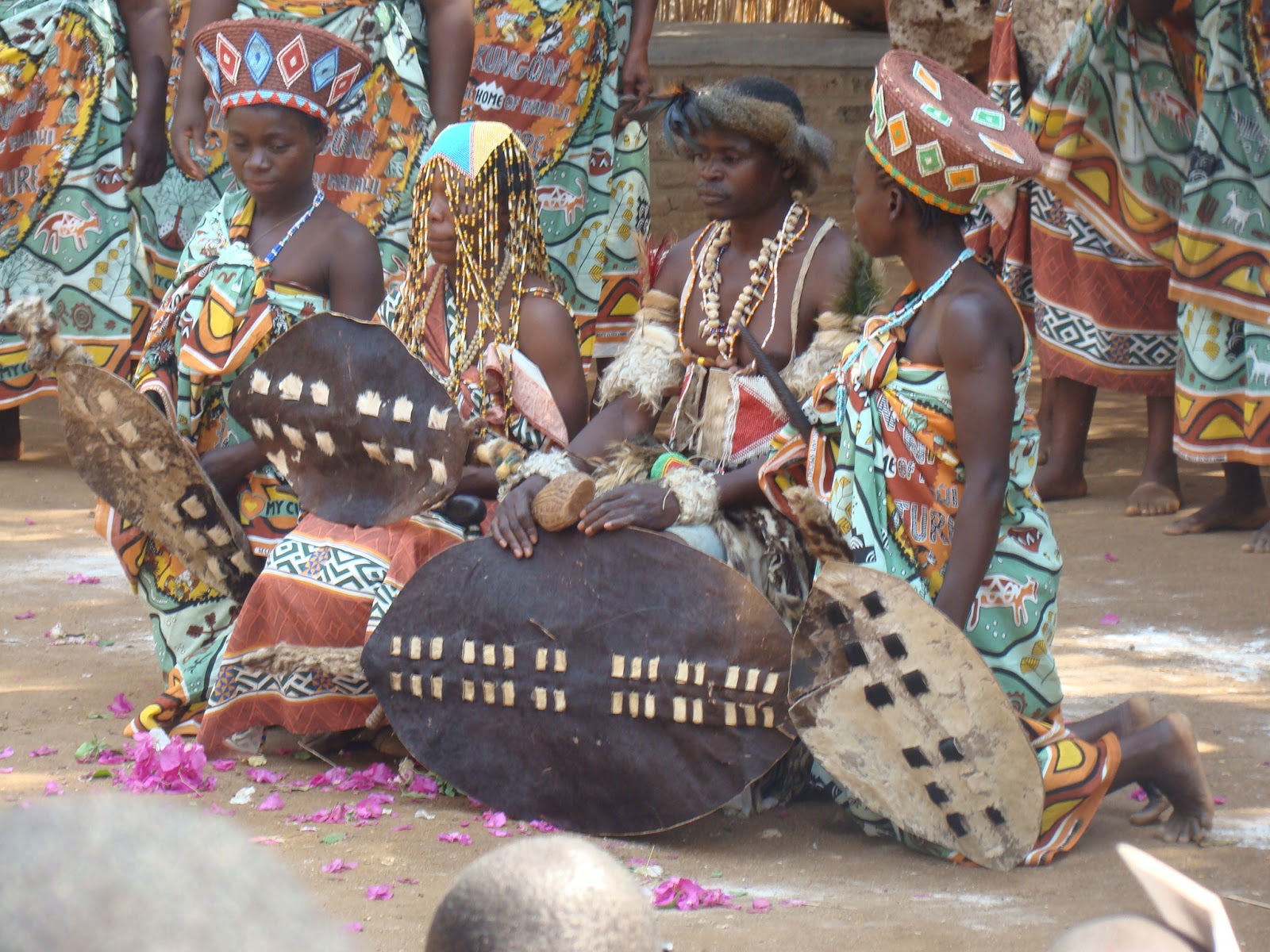
                                       A Ngoni performance of a traditional wedding ceremony

The mass was followed by a number of performances of local groups, including dances, poetry, drama, comedy and speeches.  Mua Mission with its Kungoni Centre is indeed a unique institution!

søndag 9. august 2015

A wedding - proof of contrasts

Last night I was invited to a wedding of a former NCA colleague. This became an eye opener for the huge social and economic disparities in this country.  While my previous blog was from a remote village in Nkhata Bay, I will now take you to the big ball room at Crossroads Hotel in Lilongwe.  This is one of the upmarket hotels in town.

Tables with seating for 10 were beautifully decorated, and I briefly calculated between 30 and 40 tables.  All tables were filled up with people all dressed up, surrounded by people seated around the wall since tables were not enough.  As many as 400 people attended this gala event.  The bride and bridegroom seated high up on the podium together with best man and woman and other participants of the close circle around the couple, received cascades of praises and well-wishes.
 
        The bride in the "high seat".  (My apologies for poor quality of photos taken with my phone)

A well-known personality from the main private radio station in Malawi had been hired to be Master of Ceremony, and huge loudspeakers thundered out heavy music with stomach-shaking base power.

In between presentations and speeches, the main activity of the evening was throwing of money to the couple.  Groups were called by name and danced their way to the front and threw money at the couple who greeted everyone of the guests in this way.  Later there were sessions with "ad lib" money-throwing.  On the sideline a bank had established itself in order to offer exchange of big notes into smaller denominations.  The number of notes being thrown was obviously giving quality to the party.


Bride and bridegroom receiving showers of bank notes.


                                          Dinner was of course served to all 300 - 400 guests, simple but tasty!

What was the final bottom line for this party?  I would not know, but I asked some guests what their guess would be.  I was informed that the rent of the hall would amount to about USD 2,000, while the total party easily would amount to around USD 10,000 - 15,000.  What is an average annual salary for high professional level of government employees?  I am not sure, but my guess would be around USD 8,000 - 10,000. The fact remains, however that around 80% of Malawians live on USD 1.5 per day or less: around USD 600 per year.

My observations are two:  There are huge social and economic disparities in Malawian society, and... weddings must be the ultimate symbolic proof of how your fare in the eyes of people in the community around you.

In conclusion, I enjoyed a lavish evening together with colleagues from NCA!

fredag 31. juli 2015

Change is possible...

We are seated under a tree, our guides from the Evangelical Alliance of Malawi, Birgit and I, and representatives of the small and quite remote village of Gulugulu.  NCA, through EAM is supporting a project for community-based care for children and youth.

   
                                  Playground equipment provided by NCA to Gulugulu village

We are informed about the importance of new ways of stimulating and educating children through their “children’s corner”.  Sounds and sight are those produced by nature and their creatures… until suddenly a different sound penetrates the meeting… the sound of a mobile phone!  The chairman of the “children’s corner” committee stands up, walks away from the group and starts talking loud on his phone.


                                         Meeting with the community under a tree

What a contrast!  In many ways this village is living as their ancestors have been living for generations. Their main tools are hoes to cultivate their fields, and suddenly this leap of generations into the electronic world of mobile phones and potentially social media!  Change is certainly possible.

Although this leap in time and technology, human cultures and inherited notions do not necessarily change that rapidly.  Children need to be taught that there is a relationship between the way they behave when they relieve themselves and their own health.  Why should girl-child not be given away for marriage, but be encouraged and helped to get education?  They need to learn how to straddle between learning traditional skills, and knowledge that can bring them into the wider world around them.  Their radius of operation is basically the village, and if lucky they may be offered to attend the nearest primary school.  This is a walk through the bush for 4-5 kilometers for your children of age 6-7!


                             The local community built this bridge to help access to their village

How will communities like Gulugulu manage the transformation that can close the gap between the age of hoes and that of mobile phones?  We make efforts to assist local communities to have access to skills and knowledge that can encourage their innovation and increase their options for future choices for improving their livelihood. This will have to happen with deep respect for their heritage, while exploring how short-cutting some of the many steps our own culture had to take from moving from the hoe to the mobile phone!  The wise female village chief Gulugulu expressed the wish to connect the past with the future through dynamic development of their children. Huge potentials lie ahead, and with wisdom we may contribute to constructive change!


torsdag 30. juli 2015

The emergence of a maternity ward


This week Birgit and I spend time visiting NCA supported projects.  The main reason for traveling all the way north to the Tanzanian border was to participate in a site meeting for a health center building project.  From Karonga, after having followed the tarmac road towards the border for a while we branched off to a dusty and bumpy road. In patches it is not passable in the rainy season.  As we passed by rice fields on the plains, and negotiated some tricky stretches as we climbed the hills, we certainly understood why. Eventually we reached this sign:


Msumbe Clinic is owned by the Livingstonia Synod of the Presbyterian Church, and is serving the population from far distances in this hilly area.  The current outpatient department is too small, the building partly dilapidated, and operating without running water.  There is no proper delivery facilities for expectant mothers, and the one existing staff house is sub-standard.  On this background there was need for serious upgrading and expansion. Before end of 2015 Msumbe will have a maternity ward, which in principle will look like this:

Currently the site for the ward is being leveled out through manual work carried out by people hired from the local community:

There will be a guardian shelter, which will be a facility for expecting mothers with their guardians as they wait for delivery, there will be two staff houses, and the current clinic will be upgraded.  A borehole will be sunk to secure sufficient clean water.

During the site visit drawings were consulted against terrain and current status:


The site meeting revealed encouraging progress, and the users were quite happy about the prospects of the improved facilities.


The challenge, which is the general challenge in the health system in Malawi, is to see that necessary resources are made available to secure professional health service inside the infrastructure.  This is an ongoing struggle for the owners of the clinics.  We believe that Livingstonia Synod’s commitment will be kept.  

Experiences from other maternity wards are that the number of women who deliver their babies at the ward increases dramatically when facilities are available.  The number of children who enter this world in a healthy way is increasing and the children who die at birth drop encouragingly.  We believe the infrastructure will not be another “white elephant”, but can be of valuable service!

lørdag 25. juli 2015

Joys of secondary school

What does it take for a secondary school in Norway, or somewhere else in the affluent world, to call for a major celebration with cutting of ribbon and all...?  This came to mind when I went through the local newspaper The Nation this week.  I had earlier read about the man, Robson Zgambo,  who had won the significant money prize in a lottery.  Instead of spending the money on himself or the family, he was concerned about girls in his home area of Nkhata Bay along the northern shores of Lake Malawi.  Their rate of graduation from secondary school was low, and the man wanted to contribute to their success in pursuing an educational career.  He therefore decided to use his prize money on a secondary school. What was needed to promote the girls' education?  ...Toilets...!  His wife supported him fully and shared with the newspaper that:"...the girls at the school failed to excel in their education because of lack of sanitation facilities...".  

The inauguration of the toilets was worth a celebration with cutting of ribbon and speeches by local dignitaries in addition to words of thanks from the principal and representatives of the girls. We know the physiological changes in girls when they reach puberty, and lack of sanitary facilities obviously cause regular gaps in their school attendance. I wonder if Norwegian secondary school girls would have any possibility to understand the joy of cutting the ribbon in order to access a toilet...


The story must certainly be understood in the context of Malawi.  In today's paper there was a story about a primary school that had waited for 28 years- and was still waiting - on four classrooms for their students to be built.  For all these years they had to gather under a thatched open space.  This is one of many stories that tell about the state of education in this country.

Coming back to secondary school; I met a secondary school teacher from Scotland who was an exchange teacher in Dedza, about 90 km south of Lilongwe.  She shared her experiences, and expressed a certain surprise - without good reason, according to her - that secondary school students were more or less like secondary school students in Scotland.  Some of them could not care less about education and had high levels of absenteeism, while others put all the energy and passion into their school work.  Conditions are different, but human nature seems to have a lot of similarities around the world.

Talking about Dedza, there is an interesting pottery in that place.  They are producing a wide variety of pottery with African design, partly special design made on request by customers. We have some of them in our kitchen.  What does this have to do with education?  Probably not much,... except that some people have fortunately learned important skills.

mandag 20. juli 2015

Mua Mission - history and peace of mind

There has been a long summer vacation silence from my end, but now I am back in Malawi and receiving new impressions and making new experiences.  During this last weekend Birgit and I (Birgit is here during the remainder of her summer vacation) visited Mua Mission, close to Lake Malawi.  Mua means "sugarcane" in the local language, and is a reminder of its slave trade history.  Mua was a slave market, and slaves were fed locally produced sugar canes.  Based on this history the Catholic congregation White Fathers arrived in 1902 and started building a mission station.  They saw their mission as liberation from oppressive traditions and poverty.  Mua Mission did, however not leave the local traditions behind.  In the 1970s Father Claude Bouchet started what should be Kungoni Centre of Culture & Art.  In appreciation of the value of local culture as part of living out Christianity he has over the years made impressive studies of the local history and traditions.  This has resulted in a unique museum and a centre for enculturation and training of traditional tree carving.
       
                                         Robert takes us through the local history of Mua Mission

On the premises of the Mission a small lodge with five chalets, a dining hall and conference room was built 10 years ago.  At the entrance of the dining hall a signboard and a photo document Norwegian support for the project, and Crown Princess Mette Marit opening the lodge in June 2005.

Everything at Mua Mission, including the lodge is "stamped" by the philosophical and artistic ideas of Fr. Bouchet,  Even the toilet paper-holders in the chalets express local culture - and may come across as scary in the twilight of evening or early morning.


Masks are important historically and even in today's celebration of phases of life.  Outside each chalet there is a distinct mask, and the one outside our room did not invite for slumbering in.  Somehow it reminded us more of "Scream" than slumber.

 
Mua Mission is, in spite of the distinct cultural expression a place to recover peace of mind.  The small river below the chalets gives a backdrop to the songs of birds and buzzing of insects that penetrate the otherwise dark, warm silence.  Only occasional voices from the neighbouring village remind us that we are part of a living society, not only engulfed in history and nature.

søndag 14. juni 2015

Values...and values?

Country representatives of NCA are every year called to Norway for two weeks of training and consultations. We ended this year’s weeks on Friday.  Every day starts with a small reflection.  My turn came also up.  

Some few weeks ago Ireland had a referendum on same sex marriage.  On the plane from Malawi I found an article in NY Times International about this that caught my eye.  Ireland has an overwhelming Catholic majority.  The article gave an overview showing that Catholic majority countries in general had the most liberal laws and practices. This seems to be a contradiction. In the case of Ireland, the Catholic Church – supported by the Vatican – lobbied strongly against the liberal law.  Doctrines seem to be in contrast with practice.  The context (time/place) and private interpretations override official doctrines.  There are tensions between leaders and the grassroots.
Does this have relevance to NCA?  We represent a faith-based organization.  Our main partners are faith-based organizations.  What does this mean?

Push a button and my colleagues in Malawi will deliver a sermon or a prayer.  All meetings, be it internal, with partners, with building contractors, government… start with prayers.  Is this the yardstick for being a faith-based organization?
This personal sharing reflect wide varieties of interpretations of faith and doctrines.  When translated into attitudes towards social and ethical issues, it is sometimes difficult to recognize a clear set of values that correspond with NCA’s basic documents.

The Vatican regarded the Irish referendum as a serious set-back, while the people – Catholic majority – regarded it as an important step into the future.

I have occasionally heard that NCA needs to support the progressive segments of our religions.  We have in Malawi experienced in a project called “Human Rights and Theology” that representatives of our faith partners see contradictions between the two concepts.  We are in the process of universalizing Human Rights, and there are still important battles to be won in order to have a consensus about the compatibility between theology and human rights.


It is a reality that NCA promotes values and ideas that are seen as challenging to a number of our faith based partners. How are we perceived?  Promoters of Western ideas – with a religious gloss?  Do our partners tolerate us – as long as we come with the money and “do good”?  Or do we represent a voice of change, also for some of the interpretation of values and attitudes we represent?